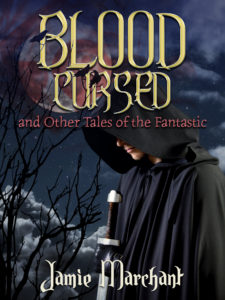
 Blood Cursed and Other Tales of the Fantastic has a shining new cover
What do you think? Tell me in the comments.
 Blood Cursed and Other Tales of the Fantastic has a shining new cover
What do you think? Tell me in the comments.
Meet my guest today, A. M. Hounchell, who writes weird (I mean this is the best possible way) and funny stuff.
 I’m just a small-town boy living in a lonely world. I grew up in a Kansan town of 300. I graduated in a class with 62 people. I was raised by my grandparents, who took me in at a young age. Now I live with my wife, Grace, and our two cats, Kiwi and Swarley.
I have exactly all my toes. That seems like a little bit about me.
2. What made you want to become a writer?
If I were to try to trace it back to when I first picked up a pen, I’d say my lack of friends. My lack friends when I was in kindergarten forced me to write my own friends and create my own rules. Then it just evolved from there. Until one day, I made friends because of my desire to create worlds.
3. Titles have always been extremely difficult for me. How do you come up with yours?
I ask myself, “Is this pun or play on words?” If the answer is no, I continue searching for a different title. Though the titles come first sometimes. It’s like they come to me wanting to adopt a plot. Like the title Psychobotomy. Still don’t know what I’m doing with that.
4. Do you have a day job in addition to being a writer? If so, what do you do during the day?
Somehow, I have a job in sales. I sell diamonds in the day and write diamonds in the rough at night. I don’t know how it happened either, so asking me is futile.
5. Tell us a little about your plans for the future. Do you have any other books in the works?
I have 28 different ideas at different stages of completion. While I am writing those ideas, I’m planning on searching for a traditional publisher. But one of my main goals is to finish a single trilogy.
6. If you could shift into any animal, which would you chose? Why? If you were going to be permanently changed into an animal? Would you still pick the same one? Why or why not?
Komodo dragon because they are going extinct. They are also cool lizards with the word dragon in their name. Their saliva is basically stomach acid. That would make me an acid spitting island dragon! Doesn’t that sound awesome!
I wouldn’t want to be a Komodo dragon forever. A lizard is a creature to be for a day rather than forever. Plus, I would never last in the sun; I have that pale vampire skin that wouldn’t translate into a predator. All the other dragons would just call me ghost and hurt my feelings. I don’t want to be a mopey dragon.
7. You’re in a tavern, and a dwarf challenges you to a duel. What do you do? What you do the same thing if the challenger were an ogre? Why or why not?
See the thing is, dwarves are very smart, so I would probably apologize and offer to buy him a drink in hopes of extending peace. On top of that, dwarves can live quite a bit longer than humans, which means he could potentially terrorize me for a long period.
As for the ogre, they aren’t very smart; they don’t live as long and are basically just the Hulk in a loin cloth. In that case, a drink might take too long for his tiny brain, so I’d offer a different challenge. I’d have to choose one that I could outsmart him in, and I’d hope for the best.
In either case, I would probably die. That seems to be the same thing.
Where can we find you online?
Blog: prosefessor.blogspot.com
Twitter: @inferno4dante
Amazon: https://www.amazon.com/AM-Hounchell/e/B01LAHL546
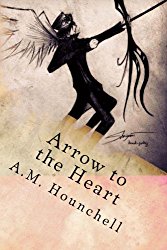 Josh is a failure at most things. When he tries to take his own life from atop an overpass, he accidentally kills Cupid, God of Love. Now, he must take up Cupid’s bow and try to spread love through the world.
But when the light pink bow starts to turn a dark purple, Josh realizes that he has no love in his heart. Once Fate, War, and Death try to take over the world, Josh can’t dispel them with the bow’s love, but he can dispel them with the bow’s sharp arrows.
If Josh wants to keep the world safe from War and Death and an oncoming hell storm, then he’ll have to fight them with vengeance as opposed to love. He will have to continue to suffer, so everyone can live.
“How did you hit me?” The man said at first, but when he looked up at the overpass, his voice changed. “Were you trying to kill yourself?” The winged man asked. He stooped over to grab his bow, but let out a yelp as blood sprayed from his broken wing. The man couldn’t bend over far enough to grab the bow, but that was the least of his problems. For some reason, he kept peering into the darkness on both sides of the street.
“I tried. I failed like always,” Josh said calmly. His anger dissipated from seeing that the angel was hurt worse than he was. How could the divine even become injured?
“Wouldn’t that be more like succeeding to live?” The man said with a stifled laugh. “There is always a reason to live, even if it isn’t as apparent as you’d like it to be. Your body will find any way to continue.”
In a daze, Josh turned to a bright light, and he heard the distinct sound of thunder. Maybe that was his light at the end of the tunnel. “Is this your solution?” The angel screamed, but not at Josh.
Josh laughed. “Thank you,” he said, holding his hands up to the sky. Just before the light was absorbed into him, the angel pushed him out of the way at the last minute. Josh landed on his face. The angel exploded like a water balloon filled with blood. It got in his eyes and blurred his vision with a tint of red, and it tasted salty on his lips. There were fragmented body parts strewn about, but the bow was the only intact piece of the angel, and it was still laying on the opposite side of the road.
Josh bent down to pick up a broken arrow. He still couldn’t believe what was happening or if it was really happening. It was like he was a puppet. “What was that guy?” Josh asked himself. As if to answer, a shiver ran up Josh’s spine. A shimmering reflective pool opened in mid air and a strangely garbed person stepped through the pool.
He was wrapped in a leather coat with a hood drawn over his head. “That was Cupid.” He kicked a partial piece of hand and snickered. “To think, I’ve been trying to kill this bastard for hundreds of years, and he dies saving your pathetic life. I mean, what is with the power of love and sacrifice? By saving your life, he is only endangering everyone else. He should’ve known that.”
Use the comments to let us know what you think. If you’re intrigued, you can find the novel here:
Last week we talked about using image to present your characters. This week I want to discuss a second way of character presentation: voice. In the same manner that you tell from a couple of words over the telephone who you’re speaking to, your readers should be able to recognize a character from her/his voice. All characters should have their own way of talking marked by difference in diction (word choice), rhythm, and style. In addition to differentiating between characters, the words a character uses and the manner of her/his speech can reveal a lot about the person.
 Blaine, who begins The Goddess’s Choice as an undersecretary in the library, reveals himself through his speech. When he is summoned by the princess, the chief librarian asks him if he has offended the princess. He replies, “I-I don’t know. I-I had no intention of doing so. I-I did see Her Highness in the clerks’ office earlier, but I did bow, and I’m sure I did it appropriately. At least, I-I think I did. I did it exactly as you said I should if I ever passed her in the halls. At least, I think I-I did.” As you can see, he talks too fast, says too much, and stammers. With these few words, the reader sees that he is very unsure of himself. This is further emphasized when the princess makes him her secretary and asks his opinion of her plans for the king’s birthday celebration. He responds, “Well, I’m sure Your Highness knows what she’s doing, and if you like things this way, I’m sure it’s a perfectly fine way to have them. I know I have very little experience, and Your Highness must have a very good reason for having—” The princess has to cut him off to get an answer.
Even without attributions, readers would never confuse Blaine with Darhour. Darhour strikes terror into the new secretary with few words. He threatens, “I am Captain Darhour, the commander of the princess’s personal guard. Her safety is my responsibility.” Darhour speaking those few words causes Blaine to fear for his life. Darhour doesn’t need to say much to cause men to “piss in their pants.”
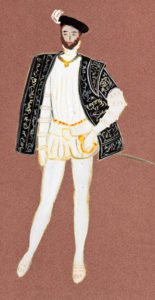
The villain of the piece, Argblutal, reveals his contempt for women by the words he uses to describe them. He tells Count Nola, “Everything about Her Highness is my business. I will marry her. No chit is going to keep me from the throne that should have been mine by right of blood.” And “chit” is one the nicer words he uses to describe her. His thoughts further the reader’s distaste for him. “The air of authority in her voice grated on the duke. His groin tightened as he thought about the deliciousness of teaching her a woman’s proper place. He imagined her naked and tied to his bed. Her breasts were a good deal smaller than he preferred. But as he imagined thrashing them with his cat-o-nine, no breasts had ever excited him more.”
To get a character’s voice right, you need to place yourself in the character’s mind. Inhabit the character and see what words come pouring out. Through it all, it’s important to remember your job is getting your readers to care about your characters. It’s impossible for him/her to care much if they all sound like carbon copies of each other.
Tell me what you think, or describe the way your favorite character speaks in the comments below.


 How can you not like a novel that mixes fantasy with chocolate? Enter Cindy Lynn Speer’s strange world and enter to win a $50 Amazon gift card below.
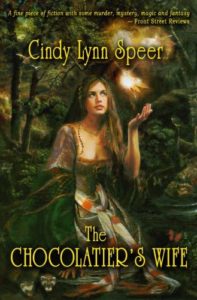
ROMANCE, MAGIC, MYSTERY…. AND CHOCOLATE
A truly original, spellbinding love story, featuring vivid characters in a highly realistic historical setting.
When Tasmin’s bethrothed, William, is accused of murder, she gathers her wind sprites and rushes to his home town to investigate. She doesn’t have a shred of doubt about his innocence. But as she settles in his chocolate shop, she finds more in store than she bargained for. Facing suspicious townsfolk, gossiping neighbors, and William’s own family, who all resent her kind – the sorcerer folk from the North — she must also learn to tell friend from foe, and fast. For the real killer is still on the loose – and he is intent on ruining William’s family at all cost.
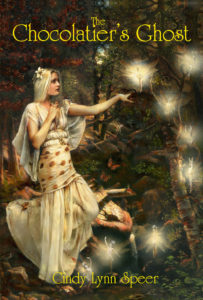
TMarried to her soul mate, the chocolatier William, Tasmin should not have to worry about anything at all. But when her happily ever after is interrupted by the disappearance of the town’s wise woman, she rushes in to investigate. Faced with dangers, dead bodies, and more mysterious disappearances, Tasmin and William must act fast to save their town and themselves – especially when Tasmin starts to be haunted by a most unwelcome ghost from her past…literally.
The Chocolatier’s Ghost is an enchanting sequel to Cindy Lynn Speer’s bestselling romantic mystery, The Chocolatier’s Wife.
Time was, in the kingdom of Berengeny, that no one picked their spouses. No one courted—not officially, at any rate—and no one married in a moment’s foolish passion. It was the charge of the town Wise Woman, who would fill her spell bowl with clear, pure water; a little salt; and the essence of roses, and rosemary, and sage. Next, she would prick the finger of the newborn child and let his or her blood drip into the potion. If a face showed in the waters, then it was known that the best possible mate (they never said true love, for that was the stuff of foolish fancy) had been born, and the Wise Woman could then tell where the future spouse lived, and arrangements were made.
For the parents of William of the House of Almsley, this process would turn out to be less than pleasant.
The first year that the baby William’s finger was pricked and nothing showed, the Wise Woman said, “Fear not, a wife is often younger than the husband.”
The second, third, and even fifth year she said much the same.
But you see, since the spell was meant to choose the best match—not the true love—of the heart the blood in the bowl belonged to, this did not mean, as years passed, that the boy was special. It meant that he would be impossible to live with.
On his seventh birthday, it seemed everyone had quite forgotten all about visiting the Wise Woman until William, who knew this of long habit to be a major part of his day–along with cake, a new toy, and a new set of clothes–tugged on his mother’s skirt and asked when they were going. She stared at him a long moment, tea cup in hand, before sighing and calling for the carriage. She didn’t even bother to change into formal clothes this time, and the Wise Woman seemed surprised to see them at all. “Well, we might as well try while you’re here,” she said, her voice obviously doubtful.
William obediently held out the ring finger on his left hand and watched as the blood dripped into the bowl. “She has dark brown eyes,” William observed, “and some hair already.” He shrugged, and looked at the two women. “I suppose she’ll do. I’m just glad ‘tis over, and that I can go on with my life.”
“For you, perhaps,” his mother said, thinking of what she would now have to accomplish.
“Do not fret, mother, I shall write a letter to the little girl. Not that she can read it, anyway.” He petted his mother’s arm. He was a sweet boy, but he was always charging forward, never worrying about feelings.
The Wise Woman rolled out an elegantly painted silk map of the kingdom and all its regions, his mother smoothed the fabric across the table, and then the Wise Woman dipped a brass weight into the bowl. Henriette, William’s mother, placed her hands on William’s shoulders as the Wise Woman held the weight, suspended, over the map.
Henriette held her breath, waiting to see where it would land. Andrew, her younger son, had his intended living just down the street, which was quite convenient. At least they knew what they were getting into immediately.
The plumb-bob made huge circles around the map, spinning and spinning as the Wise Woman recited the words over and over. It stopped, stiffly pointing toward the North.
“Tarnia? Not possible, nor even probable. You must try again!”
For once, William’s mother wasn’t being stubbornly demanding. Tarnia, a place of cruel and wild magic, was the last place from whence one would wish a bride. They did not have Wise Women there, for anyone could perform spells. The Hags of the North ate their dead and sent the harsh winter wind to ravage the crops of the people of the South. Five hundred years ago, the North and the South had fought a bitter war over a cause no one could quite remember, only that it had been a brutal thing, and that many had died, and it led to the South losing most of its magic. Though the war was long over and the two supposedly united again, memory lingered. “I have cast it twice.” The Wise Woman chewed her lower lip, but therewas naught else she could do.
“Not Tarnia, please?” Henriette, usually a rather fierce and cold woman, begged.
“I am afraid so.” The Wise Woman began cleaning up; her shoulders set a little lower. “I am sorry.”
William, staring out the window at the children playing outside, couldn’t care less. What did it matter where anyone was from? She was a baby, and babies didn’t cause that much trouble.
“Only you, William,” his mother said, shaking her head. “Why can you not do anything normal?”
This was to be the tenor of most of their conversations throughout their lives.
Cindy Lynn Speer has been writing since she was 13. She has Blue Moon and Unbalanced published by Zumaya. Her other works, including The Chocolatier’s Wife (recently out in an illustrated hardcover to celebrate its 10th anniversary) and the Chocolatier’s Ghost, as well as the short story anthology Wishes and Sorrows. When she is not writing she is either practicing historical swordsmanship, sewing, or pretending she can garden. She also loves road trips and seeing nature. Her secret side hobby is to write really boring bios about herself. You can find out more about her at www.cindylynnspeer.com, or look for her on Facebook (Cindy Lynn Speer) and Twitter (cindylynnspeer).
Welcome my guest, Adam Henderson, or the badass nameless one. No, I’m not confused the author with the character.
 Adam Henderson was born in the geographically oddity that is the ‘Gateway to Death Valley’, otherwise known as Ridgecrest, CA, which is set on the right hipbone of the Mojave Desert several hours away from everything. Sprung from a family of creative ilk, he found his desire for the wonders of writing as a high school senior and just a year later began to tackle the proverbial herd of bulls of character and world building that slowly developed into a story with all its novice luster.
Married and working as a technical writer/editor in his hometown, he enjoys a full life of serving his community, playing drums and bass, and improving his culinary skills one botched recipe at a time. A sports and film fan, he finds inspiration everywhere, discovering it’s people that fuel his writing.
I think I was always meant to be a storyteller. I was not the most extroverted kid growing up and found a lot of joy in playing with action figures, creating characters and stories. This ran its course as I grew older but still had the desire to create. In high school, as I began to read fantasy and sci-fi novels; I found myself suddenly having ideas that I knew could become a book.
2. What are your biggest literary influences? Favorite authors and why?
My biggest influencer as a fantasy writer has to be Robert Jordan whose Wheel of Time series sucked me into a vibrant world of magic, political intrigue, and best of all fleshed out characters who irritated, intrigued, and inspired me as a reader. Other authors who have impacted me are Patrick Rothfuss for his lyrical writing style, Brandon Sanderson for his creative magic systems, and Steven Erikson for his in-depth world building.
3. Tell us something about how you write? i.e. are you a plotter or a pantser? Do you have any weird or necessary writing habits or rituals?
I’m very much a plotter in the beginning of a project, but I leave enough open space so I can allow the characters and story to take turns and twists I did not anticipate. It’s a long leash approach.
The only weird habit I have is when I get stuck with where the story is going, I put on a movie or show (usually something that has swords and shields in it) and I let that inspire me. It usually always works and seems to reset my creative muscles. I find that stepping away helps me re-center my thoughts.
4. Could you tell us a bit about your most recent book?
I’ve been working on the first book of my Ravanguard series for nearly ten years now. It’s currently in its fifth revision effort, and after spending all this time with it, I’m still excited about the story and characters. I’m very much a believer in writing a fantasy series that explores the identity of the characters who make up the main narrative. Each of the three main protagonists are different, coming from different backgrounds and experiences. They each struggle through conflicts internally and externally, having to make difficult decisions. Sometimes, these decisions prove valuable and other times the consequences are dire.
5. What was the hardest part of writing your book?
The hardest part of writing the book for me has always been the long game. I envisioned this as a series and a rather long one. As I wrote over the years and began to explore the expanse of the world, I realized that it kept growing on me. While I knew I needed to rein it in, I knew also that I needed to make the right choices about how much to reveal in the first book. Stephen King said, “Good books don’t give up all their secrets at once.” I believe wholeheartedly in this statement and that’s how I approach writing epic fantasy.
6. Tell us a little about your plans for the future. Do you have any other books in the works?
If anyone wants to explore my writing style, I have an ongoing flash fiction series released on the 30th of every month and additional short stories available in my newsletters. All of these are set in a different world rich in magic and political turmoil as part of The Shoals to the Hallowed series.
As for the Ravanguard series, I am actively working on the next books and novellas. For a while, I didn’t know where the story was going after the events of the first book, so I just started writing forward. This was invaluable to me because it helped me solidify the major and some minor story arcs.
Where can we find you online?
Blog: http://adamhenderson.net/blog/
Website: http://adamhenderson.net/
Facebook: https://www.facebook.com/adamhenderson49/
Twitter: https://twitter.com/adamhenderson49
 Kerr Jaro is no longer permitted to use his name. Saved from death by the infamous mercenary unit, the Ravanguard, he now bears the title of “Nameless”. Friends are rare among the killers and miscreants whom he is supposed to trust and impress. They will name him if they find him worthy.
As the Ravanguard presses into the nation of Prenia, ambition and thoughts of plunder are sabotaged by forces they cannot identify. Unwilling to abandon their mission, Kerr must adapt as greater webs of conspiracy unfold. To survive, he needs a name, but to earn a place within the ranks of the Ravanguard could only prolong certain death.
An echo of greetings met the Noose to which he gave a simple nod, planked walkway creaking under his boots. The execution had not occurred yet. Precedence and ceremony continued high above in the sunlight while the Ravanguard waited in the depths of the chasm. For the Noose, he planned and considered all options of the new addition to the unit.
“Here he comes!” someone called from the front where the men who he called the Gallows waited.
The Noose looked up, seeing the falling body, not able to imagine the fear and emptiness of mind the hooded man endured. Did his body go through some unexplainable transformation as fear ripped away at everything he was? Some said so and there were examples of men who had taken the chasm drop and were truly disturbed. What did a man do or think as he fell into certain death? The Noose had never experienced it. No…his experience had been a short drop.
Breaths held in ready throats as the man’s body dropped like a lead weight. Every eye tracked his descent until the reinforced net anchored into the chasm wall caught him with a jerk. The sound was like a tree breaking, cracking with a wincing intensity. The Ravanguard’s engineers, the dredgers, had discovered upon dozens of tests the exactness of give and elasticity for the netting to catch and not break. The Noose’s fortitude for such things of science did not root themselves deep.
A moment of stillness followed once the netting stopped its bunging. The hooded man breathed hard before his voice came. Gibberish—high-pitched and near wailing—broke from his dried throat. Fear had not subsided. It would not for some time as he tried to make sense of the sudden stop when he should have continued to fall.
The men closest to the netting reached out and took hold of the squirming man, pulling like wolves would a fresh meal. He struggled but they were too many. His knees struck the walkway boards hard and the hood was ripped away, revealing the pale face of a man nearly scared to death. Dark, slightly curly hair like his father with sharp features like that of his mother, the Noose could place the man easily. Hopefully, none of the others would for the man’s father was a bastard at heart and had plenty of enemies. The caught man’s brown eyes squinted and searched in the dim lantern light, never settling on any one thing as the Ravanguard men crowded over him. Their cheerful welcome was a gaggle of teasing threats and pricking sarcasm as the smell of sweat filled the already compact air within the chasm. His uncertainty would only increase now.
The Noose’s eyes pressed firmly on the man who was no longer Kerr Jaro but a Nameless of the Ravanguard.
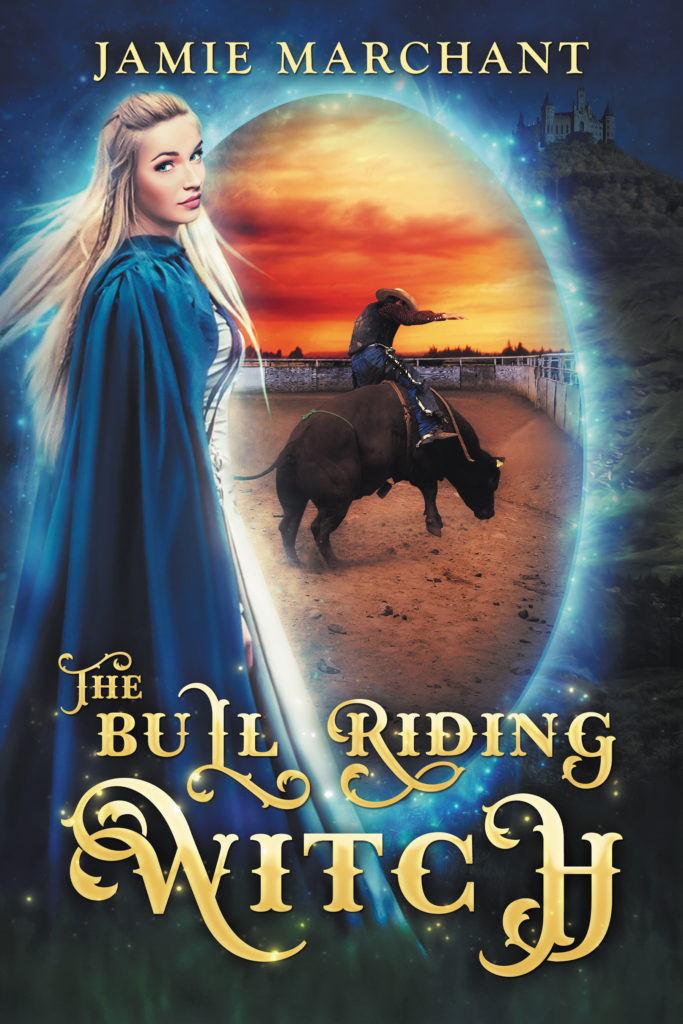
Waking up in a man’s body would ruin any princess’s morning.
Daulphina’s father, the king of Asteria, has always wanted a male heir. Unfortunately for him, Daulphina’s magic means that will never happen unless her bastard half-brother displaces her on the throne. But she’ll take on all the gods herself before she lets that happen. He isn’t nice enough to be a good king.
But apparently, the gods don’t like being challenged because she’s flung across the void and into the dumpy old trailer and chiselled body of Joshua Killenyen, a rodeo bull rider from Alabama. With nothing to eat but Frosted Flakes and no knowledge how she got there, she better find a way home before she gets her head stomped in by the bulls she must ride. Or her brother will take the throne and reduce her people to slavery. Remember, he isn’t nice.
The Bull Riding Witch will be released Monday and will be offered at a special release day price of only $.99 on Monday only. Watch the trailer to get yourself in the mood.


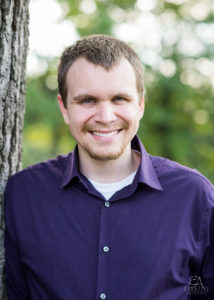 Mike Blaylock was the kid who wrote 10-pages papers when the assignment called for five. He fell in love with writing in high school and now creates stories with the intent of helping people experience great art and scandalous grace in order to better know the fulfilling God.
He’s a book lover, film geek, anime otaku, console gamer, and all around nerd who lives in Idaho with his equally-nerdy wife and their nerd-in-training.
I am an analytical art geek. That means I don’t just read books, I also study and critique them. Same with movies, anime, and video games. Same with many art types, actually.
I don’t just want to experience great art, I want to break it down and peek into the nitty-gritty of what makes it, its medium, and all art great.
Oh, and I live in Idaho with my wife and toddler boy.
2. What are your biggest literary influences? Favorite authors and why?
I owe everything to Frank E. Peretti. Not only did he get me into reading at all, not only did he get me hooked on speculative fiction, but he showed me that Christian fiction could be amazing, so that when I found out how terrible a lot of Christian fiction is, I could hold on to hope that it could still be great.
Other than him, C.S. Lewis for Christian genius, Brandon Sanderson and Brent Weeks for fantasy genius, J.K. Rowling for making me feel like a kid every time, and Harper Lee/Kathryn Stockett for drawing me into their worlds.
3. Do you think people have misconceptions about the speculative fiction? Why do you think it is a worthwhile genre?
This is an interesting question to me because I’m a Christian, and many mainstream Christians don’t go for spec fic at all, unless it’s strictly allegorical. Many think it’s Biblically wrong to do so.
That’s sad to me. Spec fic can tell Godly stories in some spectacular ways. What better way to chart the spiritual world than by delving into horror or fantasy? What better way to discuss humanity than sci-fi?
And how delightful when an author can take us someplace far, far away and make us fall in love with characters and settings that couldn’t possibly exist!
4. Could you tell us a bit about your most recent book?
Ferryman is a novella that I published specifically so I could give it away for cheap or free and let readers see my style.
It follows Charlie Ferris, a man given the worst superpower ever: the ability to kill people. How on earth do you use that without turning into a villain? That’s the question he wants to answer.
It’s a superhero character piece, focusing more on what makes a person good or bad, rather than just action spectacle.
5. Of all the characters you have created, which is your favorite and why?
I keep going back to a character whose book I keep editing and editing but never publishing: Matt Owen, hero of my story Rise. He’s the most simplistic everyman and thus very human and relatable. He’s a likable guy pushed to extremes. He also has a love-hate relationship with being the hero. Matt wants to do good, but psychological scars keep him from standing up for what is right.
I think that’s what makes him relatable. We’ve all been broken some way or another, and once we’re healed, we can do what we were made to do.
6. What is the biggest surprise that you experienced after becoming a writer?
Nobody cares.
Not too sound cynical, but just creating a book isn’t enough. You need to get away from your writing and find readers. This is radical for a task-oriented introvert like me, but that’s the truth of writing. [Jamie’s note: This was my biggest surprise as well. I thought all I had to do was write a good book.]
You have to engage with real, live people (or at least online) and make them care about you and your writing before you’ll ever sell a single copy.
But don’t worry. If you do it right, it’s a LOT more fun than it sounds.
7. Tell us a little about your plans for the future. Do you have any other books in the works?
Oh heavens, yes. “Hypocrite” is a Christian contemporary about a perfect church girl with a crush on other church girls. What does she choose? God? Instinct? Or is there more to this argument than we’re lead to believe?
“Dodecon” is a fantasy pilgrimage about twelve different races, each based on a different Zodiac sign, travelling together for a year. No evil emperor, no magic training ground, just twelve radically different people trying to embrace their differences.
Where can we find you online?
Website/Blog: https://fencingwithink.com/
Facebook: https://www.facebook.com/michaelblaylockauthor/
Twitter: https://twitter.com/Fencingwithink
Amazon: https://www.amazon.com/Michael-Blaylock/e/B00JF7WHQO/ref=sr_ntt_srch_lnk_1?qid=1498521763&sr=8-1
Others: https://www.patreon.com/michaelablaylock
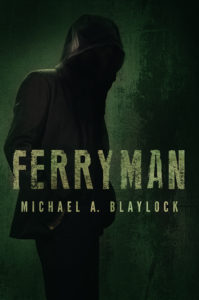 Some people can fly. Some can see impossible distances. Others can change their shape, shatter steel, or run at incredible speed.
Charlie Ferris can kill with a touch.
Contrary to what the superhuman government fears, Charlie has no dreams of world destruction. He aches for a way to use his powers for good. But as the immortal years pass, Charlie begins to fear that villainy is his only possible outcome.
But when an undying army appears out of nowhere, the superhuman world has no choice but to call in a professional killer. Charlie thinks he’s finally found his chance to make a good name for himself, but constant harassment and prejudice threaten to drive Charlie into a bloodless fury. After all, it would be so easy…and when the superheroes back him into a corner, Charlie is forced to ask what’s more important: a good reputation…or goodness?
I am on my way to kill a man, but I am not murdering him. That distinction is what keeps me from being the villain everyone already thinks I am—or at least, the villain they wait for me to become.
I am a killer, not a murderer. A murderer kills because he hates. I kill because I can. It’s the gift I was given. I didn’t choose it and I can’t return it. I’m not a killer because I kill. I kill because I am a killer, and if I’m to be accepted, I must have actions to back up my words. I must reinforce that just because I take a life, it does not make me evil.
Admittedly, it’s difficult to not cross that blurred line, especially with criminals. It’s hard not to hate a man who has murdered, corrupted, raped, or otherwise broken the law so frequently or so exquisitely that the state has decided to end their life. Thus, when the state calls me, I don’t ask what crimes the condemned has committed. I just ask for proper, public documentation to make sure nobody is trying to trick me into offing a political enemy.
People think I’m shady as it stands—at least, those who recognize me. Thankfully, I’m innocuous enough to the naked eye—just another thirty-ish white male in a country full of them. My hair is a bit wavy, but that doesn’t signal me as a killer. Its inky color might, though. And I suppose my dark, button-up shirt, black slacks, raven gloves, and shiny shoes make me look rather . . . well, grim. But this job and this life require professionalism and appropriate somberness. Glib mockery only enhances suspicion.
My shoes clap lightly on tiled floors. These back hallways are well lit, clean, and a lovely way to bypass the inmates of this maximum-security prison. I’m not scared of them. I just don’t want to run the risk of hating them.
The security guard who escorts me is armed to the throat and thankfully, silent. Some escorts like to chat me up, ask a lot of questions about what I do, or worst of all, tell me how the inmate has it coming. I prefer to remain as silent about my talents as I can, not glorify them unnecessarily. I don’t like this job per se, but I like getting paid, you know?
He opens a door with a security key and lets me inside. The room is sparsely furnished with a few cabinets, a sink, and a scrawny black man strapped to a reclining chair. He can still move his head, so he turns and looks me in the eye.
“You’re the guy?” he asks.
I nod. “I’m the guy.”
I always feel I should introduce myself, but what am I supposed to say? Hi, I’m Charlie. I’m here to kill you.
So few people here. True, we have two doctors, a state official, a chaplain, and the spectacled warden whom I have met before—this is Texas, after all—but no family or friends are here to comfort the condemned. I’ve been to plenty of executions and there’s always somebody who loves the prisoner and stays with them until the end.
Poor guy.
The warden shakes my hand first, as if to show the others it’s okay. The doctor and state official are more hesitant to touch me, even with the gloves.
I give them each a firm shake, as if to say, “I’m not here for you.”
If Michael has intrigued you, you can find his book here: